

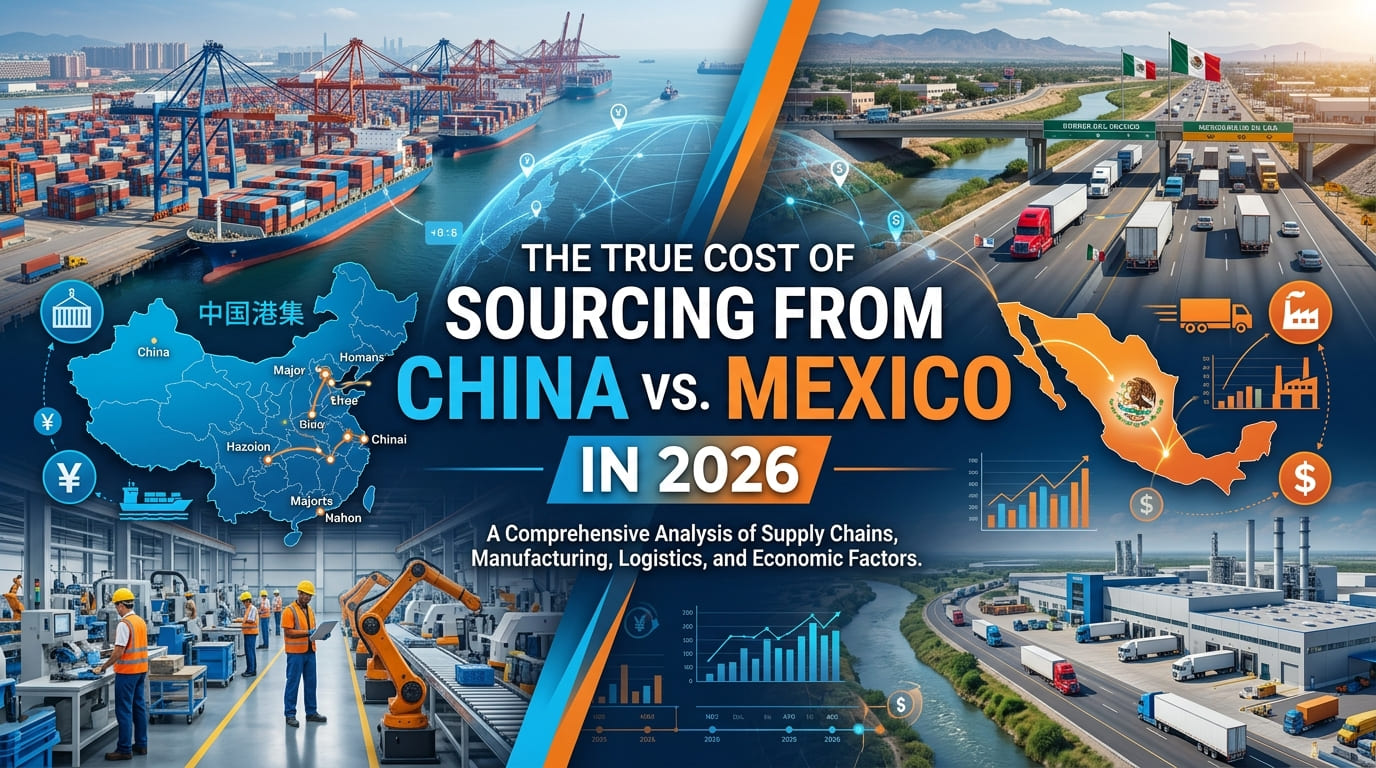
The True Cost of Sourcing from China vs. Mexico in 2026
If you're a U.S. retailer running the numbers on where to source your next product line, the china vs mexico sourcing cost comparison looks very different in 2026 than it did five years ago. China's per-unit prices have long been the benchmark — but once you factor in Section 301 tariffs, post-pandemic shipping volatility, 60-to-90-day lead times, and a growing list of hidden costs, the math no longer works the way it used to. Mexico and Latin America have quietly closed the gap, and for many SMB retailers, nearshoring is now the sharper pencil.
This article breaks down the real numbers: total landed cost, lead times, compliance costs, cash flow impact, and every line item that doesn't show up on a supplier's quote sheet.

Why China Tariffs in 2026 Change the Entire Calculation
Section 301 tariffs — first imposed in 2018 and expanded since — now add 25% or more to the cost of most goods imported from China. For many apparel, home goods, and accessories categories, that number is higher. In 2025, ongoing trade policy uncertainty means importers are also pricing in the risk of further escalation, which creates a structural premium on Chinese-sourced inventory.
Here's what that looks like in practice:
- A $10 FOB unit from a Chinese factory becomes $12.50+ after a 25% tariff before it even touches U.S. soil.
- Add ocean freight ($1.50–$3.00/unit depending on category and container utilization), port handling fees, customs brokerage ($150–$500/shipment), and first-mile domestic freight, and you're often looking at $15–$18 total landed cost on a $10 FOB unit.
- If there's a port congestion delay — which remains a real risk at major West Coast ports — you're adding warehousing costs and the inventory carrying cost of capital sitting idle for weeks.
The tariff burden alone represents a structural disadvantage that low Chinese labor costs no longer fully offset for most mid-market product categories.
The Nearshoring Lead Time Advantage: 14 Days vs. 60–90 Days
Lead time is a cost. It's just a cost that doesn't appear on your purchase order.
When you source from China, you're typically looking at 60 to 90 days from order to delivery — and that assumes no supply chain disruptions, no inspection holds, and no vessel space issues. For seasonal businesses, this means you're committing capital to inventory three months before you know whether your sell-through will justify it.
Nearshoring — sourcing from Mexico and Latin America — compresses that to as little as 14 days. Factories in Mexico, Colombia, Peru, and other LATAM countries can ship to U.S. distribution centers by truck or short-haul freight, bypassing ocean freight entirely for Mexican suppliers operating under USMCA.
The financial impact of shorter lead times:
- Inventory turns improve. You can order closer to demand signals rather than forecasting three months out.
- Markdown risk drops. Less inventory sitting in transit means less inventory you're discounting to clear.
- Cash flow improves. Capital isn't locked in product that's on a ship for six weeks.
- Re-orders become viable. With 14-day replenishment, you can chase winners instead of over-ordering at the start of a season.
For a $500,000/year buying operation, improving inventory turns from 3x to 5x can free up six figures in working capital. That's a real number — and it's invisible in a simple per-unit cost comparison.

Total Landed Cost Comparison: China vs. Mexico
The table below compares the full cost stack for a hypothetical mid-market apparel order. Assumptions: 500 units, $10 FOB, typical retail category (apparel/accessories).
| Cost Component | China | Mexico (via USMCA) |
|---|---|---|
| FOB Unit Price | $10.00 | $11.50–$12.00 |
| Section 301 Tariff (25%) | $2.50 | $0.00 (duty-free under USMCA) |
| Ocean/Freight per unit | $1.75 | $0.50–$0.75 (truck/short haul) |
| Customs Brokerage (per unit) | $0.40 | $0.15 |
| Port/Handling per unit | $0.35 | $0.05 |
| Quality Inspection | $0.50–$1.00 | $0.25–$0.50 |
| Inventory Carrying Cost (90 vs 14 days) | $0.60–$1.00 | $0.10–$0.20 |
| Currency Risk Premium | $0.20–$0.40 | Minimal (USD-adjacent) |
| Estimated Total Landed Cost | $16.30–$17.40 | $12.55–$13.65 |
Note: FOB prices vary significantly by factory, category, and order volume. These are illustrative ranges based on 2026 market conditions. Your actual numbers will differ — but the structural cost drivers hold across most categories.
The key insight: Mexico's slightly higher FOB price is more than offset by the elimination of Section 301 tariffs, lower freight costs, and the compounding effect of shorter lead times on working capital.

USMCA: The Duty-Free Advantage Most Retailers Are Leaving on the Table
The United States-Mexico-Canada Agreement (USMCA) allows qualifying goods manufactured in Mexico to enter the U.S. duty-free or at significantly reduced rates. For apparel, home goods, food products, and many consumer goods categories, this means zero import duty — a direct 25%+ cost advantage over equivalent Chinese-sourced goods.
Most SMB retailers are not fully leveraging USMCA because:
- They don't have relationships with verified Mexican or LATAM factories.
- They're uncertain about Rules of Origin requirements for qualification.
- They're handling their own customs compliance, which adds complexity.
The solution to all three is working with a sourcing partner that handles the Importer of Record function and has pre-vetted LATAM supplier networks. When you source through FastLane's verified factory network, USMCA compliance and customs handling are built into the service — you don't need a customs attorney to capture the duty savings.
Mexico Manufacturing Cost: What the Data Actually Shows
A common misconception is that "made in Mexico" means lower quality or limited product categories. The reality in 2026 is more nuanced:
- Apparel and textiles: Mexico and Central America have mature garment manufacturing infrastructure, particularly in the Bajio region and Central American free trade zones. Quality benchmarks are comparable to Chinese factories in the same tier.
- Home goods and accessories: Colombia, Peru, and Brazil have growing manufacturing capacity in furniture components, ceramics, leather goods, and lifestyle accessories.
- Food and consumables: Mexico is already the largest supplier of food products to the U.S. — USMCA infrastructure is well-established.
- Labor cost gap is narrowing: Chinese labor costs have risen significantly over the past decade. The wage gap between Chinese and Mexican manufacturing workers in comparable factory environments has compressed substantially.
What LATAM factories still offer that Chinese factories can't match: proximity, responsiveness, and relationship-based business culture that aligns well with U.S. SMB buyers who want direct communication rather than trading company intermediaries.
The Hidden Costs of China Sourcing That Never Show Up on a Quote
The FOB price from a Chinese supplier is the starting point of the cost conversation, not the ending point. Here are the costs that routinely get underestimated:
Quality inspection and remediation. Factory audits, pre-shipment inspections, and AQL testing add $200–$800 per shipment. If a production run fails inspection, the cost of rework, re-inspection, and delayed delivery can be substantial. Remote management of quality issues from 8,000+ miles away is genuinely difficult.
Long payment terms and currency risk. Many Chinese suppliers require 30% deposit at order, 70% before shipment. Your capital is committed months before you receive goods. USD/RMB currency movements add a risk premium that's often unhedged for SMB buyers.
Intellectual property exposure. Not unique to China, but the risk of design duplication is higher in high-volume, low-relationship factory environments. This is particularly relevant for retailers with proprietary designs or private label programs.
Communication and relationship overhead. Time zone differences, language friction, and the cost of building and maintaining supplier relationships at distance are real overhead costs — even if they don't appear on a spreadsheet.
Supply chain concentration risk. The COVID disruptions of 2020–2022 and ongoing geopolitical tension have given supply chain concentration risk a hard dollar value. Single-country sourcing strategies carry a risk premium that diversification to nearshore suppliers can reduce.
Low MOQ Sourcing: Why It Changes the Risk Profile Entirely
One of the structural advantages of China sourcing has historically been the ability to produce very high volumes at very low unit costs. But for SMB retailers, that's often a liability, not an asset.
A 500-unit MOQ on a new SKU means you're betting $8,000–$15,000 on a product before you know if your customers will buy it. If the product underperforms, you're discounting or writing off inventory.
Nearshore factories — particularly those in FastLane's verified network — offer low or no minimum order quantities. You can test a new product at 50 units, validate demand, and reorder in two weeks instead of committing to a 500-unit Chinese production run three months before you'll see a single sale.
For SMB retailers, this fundamentally changes the risk calculus of product development and inventory management. The per-unit cost may be marginally higher at small quantities, but the total program risk is dramatically lower.
Explore FastLane's verified LATAM factory network to see what's available with low MOQs across apparel, home goods, and accessories.
Who Handles Customs When You Nearshore?
One practical question that holds many retailers back from nearshoring: "Who handles the import paperwork?"
When you buy from Chinese suppliers, you're typically the Importer of Record — responsible for tariff classification, duty payment, CBP compliance, and any issues that arise at the border. Most SMB retailers handle this through a customs broker, which adds cost and complexity.
FastLane operates as the Importer of Record (IOR) for goods moving through its platform. This means:
- FastLane handles all customs documentation, duty classification, and CBP filings.
- Retailers receive a single, transparent invoice — no separate customs broker bill, no surprise duty assessments.
- USMCA qualification and Rules of Origin documentation are handled in-platform.
This removes a significant operational burden and eliminates the compliance risk that comes with self-managing import logistics.
China vs. Mexico Sourcing: Which Is Right for Your Business?
The answer depends on your product category, order volume, cash position, and risk tolerance. Here's a practical framework:
Mexico/LATAM sourcing is likely better if: - Your order quantities are under 1,000 units per SKU - You need replenishment cycles under 30 days - Your product category qualifies for USMCA duty-free treatment - You want to reduce capital tied up in transit inventory - You're testing new products and need low MOQ flexibility
China sourcing may still make sense if: - You're sourcing highly commoditized, high-volume goods where per-unit cost is the only variable - Your product category does not have equivalent manufacturing capacity in LATAM - You have established factory relationships that offset the management overhead - You have sufficient working capital to absorb 90-day inventory cycles
For most SMB retailers in apparel, home goods, gifts, and accessories — the categories where LATAM manufacturing is strongest — the total landed cost and operational flexibility advantages of nearshoring outweigh the FOB price premium in 2026.
See how FastLane's marketplace works and what it costs to get started.
FAQ: China vs. Mexico Sourcing Costs
Is manufacturing in Mexico cheaper than China in 2026?
On a total landed cost basis, Mexico is often cheaper for U.S. retailers in 2026. While Mexico's FOB factory prices are typically 10–20% higher than comparable Chinese factories, USMCA duty-free treatment eliminates the 25%+ Section 301 tariffs that apply to most Chinese goods. Add lower freight costs, shorter lead times, and reduced inventory carrying costs, and the total landed cost from Mexico frequently beats China for mid-market product categories.
What are Section 301 tariffs and how much do they add to China sourcing costs?
Section 301 tariffs are U.S. trade duties imposed on Chinese goods, ranging from 7.5% to 25% or higher depending on the product category. For most apparel, home goods, and consumer products, the rate is 25%. On a $10 FOB unit, that adds $2.50 in duty before freight, handling, or any other costs. These tariffs have been in place since 2018 and have not been substantially reduced under any recent administration.
How long does shipping from Mexico to the U.S. take compared to China?
Shipping from Mexico to U.S. distribution centers typically takes 3–14 days via truck freight. Ocean freight from China to U.S. ports takes 25–35 days for transit alone, with total lead times from order to delivery running 60–90 days when production time is included. The lead time compression from nearshoring represents a significant working capital advantage for retailers.
What is USMCA and which products qualify for duty-free treatment?
USMCA (United States-Mexico-Canada Agreement) is a free trade agreement that allows qualifying goods manufactured in Mexico and Canada to enter the U.S. duty-free. Qualification depends on Rules of Origin requirements, which vary by product category. Apparel must meet yarn-forward or fabric-forward rules; other goods have regional value content thresholds. Working with a sourcing partner that handles IOR and compliance documentation simplifies the qualification process.
What does "total landed cost" mean in wholesale sourcing?
Total landed cost is the complete cost of getting a product to your warehouse, including: FOB factory price, import duties and tariffs, ocean or truck freight, customs brokerage fees, port handling, insurance, and first-mile domestic freight. It's the number you should use for margin calculations, not the FOB price. In China sourcing, the gap between FOB price and total landed cost is typically 50–80% on top of FOB. In Mexico nearshoring, that gap is typically 15–30%.
Are there minimum order quantities when sourcing from Latin America?
MOQ requirements vary by factory and product category, but nearshore factories — particularly those operating through platforms like FastLane — often offer significantly lower MOQs than Chinese factories. FastLane's verified factory network supports low and no-MOQ sourcing, allowing retailers to test products at small quantities and reorder quickly as demand validates. This is a structural advantage over traditional China sourcing, where 500+ unit MOQs are common.


