

What Is Nearshoring? A U.S. Retailer's Complete Guide (2026)
If you've spent any time sourcing products for your retail business, you've probably heard the term nearshoring thrown around more and more. But what is nearshoring, exactly — and why should a boutique owner or wholesale buyer in the U.S. care about it right now?
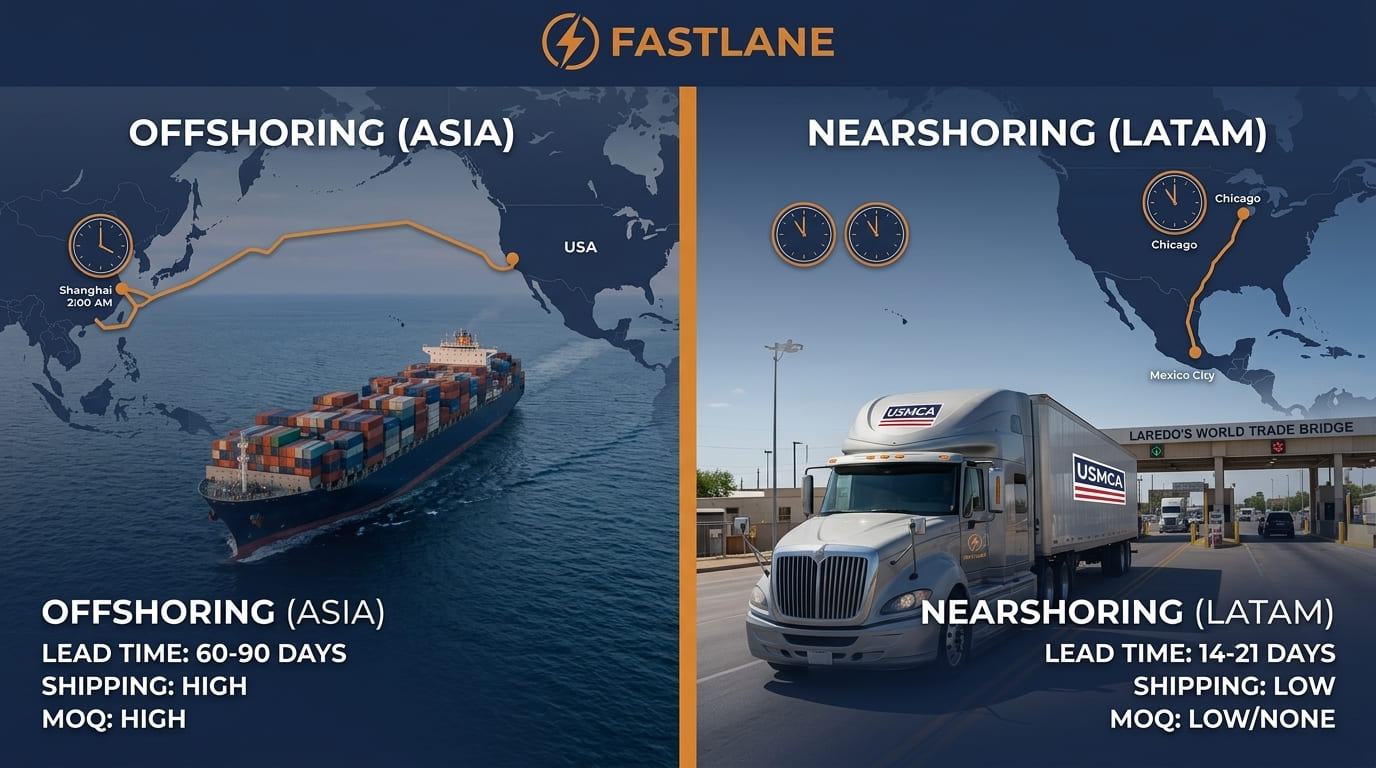
The short answer: nearshoring is changing how American retailers source inventory. Instead of waiting 8–10 weeks for a container from Asia, retailers are discovering they can get the same quality goods from factories in Latin America — delivered in as little as 14 days. This guide breaks down exactly how it works, how it compares to traditional offshoring, and how to find nearshoring suppliers in the USA market.
The Nearshoring Definition: What It Actually Means
Nearshoring refers to the practice of sourcing goods or services from a country that is geographically close to your own — as opposed to sourcing from distant, low-cost regions like Southeast Asia or China.
For U.S. retailers, nearshoring almost always means Latin America: Mexico, Colombia, Peru, Guatemala, and other LATAM countries that sit within the same time zones and within a fraction of the shipping distance from the U.S.
The term is borrowed from the tech and business services world, where companies "nearshore" software development or call center operations to nearby countries. In manufacturing and wholesale, the logic is identical: you trade the maximum cost savings of far-off production for speed, flexibility, and lower risk — while still getting competitive pricing.
Think of it as the middle path between: - Onshoring — manufacturing domestically in the U.S. (highest cost, highest control) - Offshoring — sourcing from Asia or Eastern Europe (lowest cost, longest lead times) - Nearshoring — sourcing from LATAM neighbors (competitive cost, fast lead times, cultural alignment)

Nearshoring vs. Offshoring: What's the Real Difference?
The nearshoring vs. offshoring debate comes down to one thing for most retailers: lead time vs. unit cost.
| Factor | Offshoring (Asia) | Nearshoring (LATAM) |
|---|---|---|
| Lead time | 60–90 days | 14–21 days |
| Shipping cost | High (ocean freight) | Low (ground/air) |
| MOQ (minimum order qty) | High (300–1,000+ units) | Low to none |
| Customs complexity | High | Reduced (USMCA) |
| Communication | Time zone gaps | Aligned with U.S. hours |
| Quality visibility | Hard to audit remotely | Easier, closer proximity |
| Tariff exposure | High and volatile | Lower, treaty-protected |
For the past two decades, offshoring to China dominated wholesale sourcing because unit costs were simply unbeatable. But that calculus has shifted:
- Tariffs on Chinese goods have climbed significantly and remain unpredictable
- Freight costs spiked post-COVID and have not returned to pre-2020 levels
- Inventory risk from 90-day lead times means retailers over-order to hedge, tying up working capital
- Consumer demand has become faster-moving, making 3-month lead times a competitive liability
Nearshoring solves these problems without requiring you to pay U.S. manufacturing prices.
Why LATAM? The Case for Latin American Wholesale
Latin America has quietly built manufacturing infrastructure that rivals Asia in categories like apparel, footwear, home goods, furniture, and gift products — the exact categories that matter most to U.S. SMB retailers.
Here's why LATAM nearshoring works specifically well for U.S. retail:
Geographic Proximity
Mexico shares a land border with the U.S. Countries like Colombia and Peru are 3–5 hour flights from major U.S. cities. Product can move by ground, air freight, or consolidated ocean shipment — all dramatically faster and cheaper than Asia.
The USMCA Advantage
The United States-Mexico-Canada Agreement (USMCA) is the trade framework that governs U.S.-Mexico commerce. For retailers sourcing from Mexico, this means preferential tariff treatment on qualifying goods — often 0% duty on eligible product categories. This isn't a minor footnote. On a $50,000 wholesale order, even a 10% duty difference is $5,000 back in your pocket.
No comparable trade agreement exists between the U.S. and China or Vietnam.
Manufacturing Quality in Apparel and Home Goods
Mexico and Colombia in particular have multi-generational expertise in textile and apparel manufacturing. Peru is globally recognized for premium cotton. These aren't discount-grade factories copying mass-market designs — many produce for global brands and meet international quality standards.
Cultural and Business Alignment
LATAM factories generally operate with U.S. business culture norms: email communication, digital invoicing, responsiveness within business hours. Contrast that with Asia, where factory communication often requires a local agent or importer as intermediary.

How Nearshoring Actually Works for a U.S. Retailer
Understanding the concept is one thing. Here's what the sourcing process actually looks like in practice.
Traditional offshoring workflow: 1. Find a factory (often through Alibaba or a sourcing agent) 2. Request samples — wait 2–4 weeks 3. Negotiate MOQs (typically 300–1,000+ units per SKU) 4. Place order — wait 8–12 weeks for production 5. Arrange freight forwarding, customs broker, port pickup 6. Receive goods — hope nothing is held at customs 7. Total elapsed time: 4–6 months from first contact to shelf
Nearshoring workflow via a marketplace like FastLane: 1. Browse verified LATAM factories on FastLane's product catalog 2. Select SKUs with no or low MOQs 3. Place order with transparent landed cost (no surprise fees) 4. Customs and import handled automatically (Importer of Record service) 5. Goods arrive in 14 days 6. Replenish as needed — no bulk order required
The difference isn't just speed. It's inventory model. When your lead time is 14 days instead of 90, you can order closer to demand — which means less overstock, less discounting, and better cash flow.
Finding Nearshoring Suppliers for the U.S. Market
The biggest friction point for most retailers is finding vetted nearshoring suppliers — not fly-by-night operations, but established factories with proven quality and the ability to fulfill U.S. wholesale orders reliably.
Here's how to approach it:
Option 1: Trade Shows
Expos like Expo Moda (León, Mexico) or Colombiatex (Medellín) bring together hundreds of LATAM manufacturers. The downside: you need to travel, and vetting quality, pricing, and fulfillment capability takes time.
Option 2: Sourcing Agents
Bilingual sourcing agents based in Mexico or Colombia can introduce you to factories and negotiate on your behalf. This adds cost (typically 5–15% commission) and still requires you to manage customs and logistics independently.
Option 3: B2B Nearshoring Marketplaces
The most efficient entry point for SMB retailers is a purpose-built platform. FastLane is the only B2B marketplace designed specifically for U.S. retailers sourcing from LATAM, with:
- 118+ verified factories across apparel, footwear, home goods, and furniture
- 8,300+ live SKUs with transparent wholesale pricing
- Importer of Record (IOR) service built in — FastLane handles all customs, duties, and logistics so you receive a single clean invoice
- No vendor fees — factories list for free, meaning you're not paying markup on top of markup
- 14-day delivery as the standard, not an exception
Compared to Faire (domestic only, no nearshoring), Alibaba (Asia-focused, no IOR, high MOQs), or Tundra (limited to domestic U.S.), FastLane is purpose-built for the nearshoring opportunity.

The Importer of Record: The Detail Most Retailers Miss
One reason many U.S. retailers hesitate on international sourcing — even from LATAM — is the customs and import process. It's opaque, it's slow, and one mistake can hold your shipment for weeks.
The Importer of Record (IOR) is the legal entity responsible for ensuring an imported shipment complies with all U.S. customs regulations. Normally, that responsibility falls on you, the retailer — requiring a licensed customs broker, an EIN filed with CBP, knowledge of HTS codes, and ongoing compliance management.
FastLane's IOR service means FastLane assumes that responsibility on your behalf. You don't need a customs broker. You don't need to know what an HTS code is. You receive your goods cleared and delivered, with a single transparent invoice covering the full landed cost.
For boutique owners who got into retail to sell products — not to manage import compliance — this is a genuine unlock.
Is Nearshoring Right for Your Retail Business?
Nearshoring isn't a fit for every product category or every retailer. Here's an honest breakdown:
Nearshoring is a strong fit if: - You sell apparel, accessories, home goods, gift products, or furniture - You want faster inventory turns with lower MOQ commitments - You're exposed to Asia tariff risk and want to diversify your supply chain - You need flexibility to replenish in-season without a 90-day wait - You want to reduce customs complexity
Nearshoring may not be the right primary source if: - You need highly specialized technical components not available in LATAM - Your margins require the absolute lowest unit cost achievable globally, regardless of lead time - Your category is dominated by proprietary Asian IP (certain electronics, for example)
For most U.S. SMB retailers in soft goods, home, and gifts, nearshoring is at minimum a diversification play worth piloting — and increasingly, it's becoming the default supply chain strategy.
FAQ: Nearshoring for U.S. Retailers
What is the difference between nearshoring and offshoring?
Nearshoring means sourcing from geographically nearby countries — for U.S. retailers, that typically means Latin America. Offshoring refers to sourcing from distant countries like China, Vietnam, or Bangladesh. The main trade-offs are lead time (14 days nearshore vs. 60–90 days offshore), tariff exposure, and inventory flexibility. Nearshoring generally wins on speed and supply chain agility; offshoring can still offer lower unit costs in some categories.
Why are U.S. retailers switching to LATAM suppliers?
Several converging factors have made LATAM sourcing attractive: rising tariffs on Chinese goods, post-COVID freight volatility, faster trend cycles that demand shorter lead times, and the USMCA trade agreement, which gives preferential tariff treatment to U.S.-Mexico trade. Retailers in apparel, home goods, and gifts are finding LATAM quality competitive with Asia at significantly faster turnaround.
Do I need a customs broker to import from Mexico or LATAM?
Normally, yes — importing from any foreign country requires navigating U.S. Customs and Border Protection, which involves HTS codes, duties, and compliance filings. However, platforms like FastLane offer an Importer of Record (IOR) service that handles all of this on your behalf. You receive a single invoice covering the full landed cost, with no customs complexity on your end.
What is a good minimum order quantity (MOQ) for nearshoring?
One of the key advantages of LATAM nearshoring over Asian sourcing is lower MOQs. Where Asian factories often require 300–1,000+ units per SKU, many LATAM factories on platforms like FastLane offer low or no MOQ options. This allows SMB retailers to test new products without large inventory commitments.
Is Mexico manufacturing quality good enough for U.S. retail?
Yes — Mexico, Colombia, and Peru have developed manufacturing capabilities that serve global brands in categories like apparel, leather goods, footwear, home textiles, and furniture. Many LATAM factories operate at international quality standards and already export to Europe and the U.S. FastLane pre-vets all factory partners before listing them on the platform.
How does USMCA affect nearshoring from Mexico?
The United States-Mexico-Canada Agreement (USMCA) — which replaced NAFTA — establishes preferential tariff rates, including 0% duties on many qualifying product categories traded between the U.S. and Mexico. For retailers sourcing apparel, textiles, or home goods from Mexican factories, USMCA can eliminate or significantly reduce import duties compared to sourcing from non-treaty countries. This is a structural cost advantage that is not available to retailers sourcing from Asia.
FastLane is the B2B nearshoring marketplace purpose-built for U.S. retailers. Browse 8,300+ wholesale SKUs from verified LATAM factories at fastlanetrade.com — with 14-day delivery and zero import hassle.


