

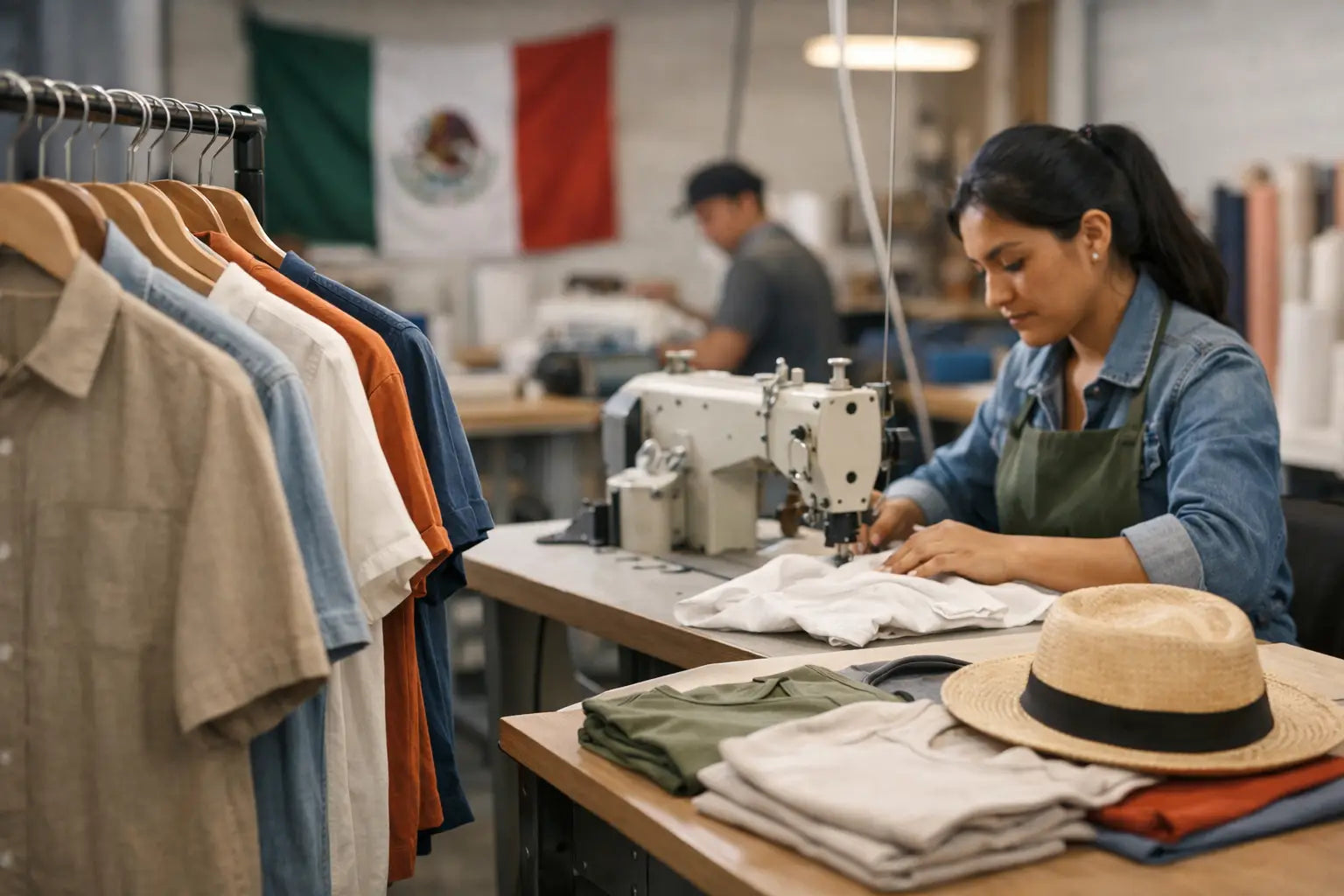
If your last apparel order forced you to overbuy just to hit a factory minimum, you already know the real cost of bad sourcing. Working with low MOQ clothing manufacturers Mexico buyers can actually scale with changes that equation fast - less dead stock, shorter lead times, and a lot more control over how you test, launch, and replenish product.
For U.S. brands, that matters more than ever. Apparel moves on timing. Trends shift, sizes sell unevenly, and private label programs rarely benefit from committing to huge runs before demand is proven. Mexico has become a practical manufacturing option for buyers who want smaller minimums without accepting the delays and communication gaps that often come with offshore production.
Why low MOQ clothing manufacturers in Mexico stand out
Low MOQ is not just a convenience. It is a margin and inventory strategy. When a manufacturer can support smaller opening orders, brands can test new categories, expand colorways, launch capsule collections, and react to demand without tying up too much cash in inventory that may sit.
Mexico strengthens that advantage because the low-minimum model is paired with geography. U.S. buyers are not only looking for a factory willing to produce fewer units. They are looking for a supply chain that can move faster, communicate clearly, and reduce the risk built into long-distance sourcing. Mexico checks those boxes in a way that makes small-batch production commercially useful, not just technically possible.
Lead times are typically shorter than Asia-based sourcing. Time zone alignment makes production follow-up easier. Freight can be more predictable. And when issues come up - labeling changes, packaging revisions, fit adjustments, or replenishment shifts - buyers are in a better position to respond before a problem turns into excess cost.
What "low MOQ" really means in apparel
This is where buyers need to stay sharp. Low MOQ does not mean the same thing across every clothing manufacturer in Mexico. One factory may define low MOQ as 50 pieces per style. Another may mean 300 pieces per color. A third may accept small runs only if you choose stock fabrics, standard trims, or simpler construction.
That trade-off is normal. Lower minimums often work best when the product is operationally simpler. If you want fully custom knit fabric, specialized washes, branded hardware, custom packaging, and extended size grading, the MOQ usually rises because the factory is absorbing more setup complexity.
The right question is not just, "What is your MOQ?" It is, "What MOQ applies to this exact product configuration?" Buyers who ask that early get clearer quotes and avoid expensive resets later.
The best fit for U.S. brands and retail buyers
Mexico is especially attractive for businesses that need flexibility more than ultra-large volume economics. That includes emerging apparel brands, private label retailers, e-commerce sellers, boutique chains, uniform programs, hospitality groups, and wholesalers testing regional assortments.
If your business depends on frequent launches, seasonal refreshes, or replenishing top sellers without carrying months of backup inventory, low MOQ production can protect cash flow. It can also improve forecasting because you are not forced to place oversized orders just to access manufacturing.
That said, not every buyer should optimize for the smallest possible minimum. If a style is already proven, fabric consumption is consistent, and reorder velocity is strong, larger production runs may offer better unit costs. The smart move is not automatically choosing the lowest MOQ. It is matching MOQ strategy to demand certainty.
How to evaluate low MOQ clothing manufacturers Mexico buyers are considering
The first screen should be capability, not price. A factory may offer a small minimum, but if it cannot deliver the fabric quality, construction standards, compliance requirements, or finishing your brand needs, the low MOQ becomes irrelevant.
Start with product specialization. Some manufacturers are stronger in knitwear, basics, uniforms, athleisure, or cut-and-sew private label. Others may focus on denim, woven garments, or fashion-forward small runs. The closer the factory is to your category, the lower the production risk.
Then look at how the manufacturer handles development. Ask how they quote samples, whether they can source materials locally, what customization options are available, and how they manage size sets, labeling, packaging, and revisions. A low MOQ partner should still have a disciplined process. Small orders do not excuse inconsistent execution.
Communication also matters more than many buyers expect. Low-volume programs often involve more adjustments because they are tied to product testing and iterative launches. If the supplier is slow to answer, vague on timelines, or unclear about approval steps, the flexibility you thought you were buying disappears quickly.
What buyers should ask before requesting a quote
A useful quote request gets specific fast. Generic inquiries usually produce generic pricing, and generic pricing rarely survives product development.
Share your estimated order quantity by style, color, and size range. Clarify whether the product is fully custom, private label, or white label. State your target fabric, expected quality level, trim requirements, and packaging needs. If you have a tech pack, include it. If you do not, at least provide reference images and call out the details that cannot change.
You should also ask about sample lead times, production lead times, material sourcing timelines, and how MOQ changes if you consolidate multiple styles. In some cases, factories can be more flexible when total order volume is spread across a collection. In other cases, each style must stand on its own. That distinction affects cost planning.
It is also worth asking where the pressure points are. Sometimes the constraint is not sewing capacity. It is fabric dyeing minimums, trim customization, or packaging setup. Knowing that helps you design a sourcing plan that stays flexible without compromising the product.
Cost, speed, and flexibility - the real trade-offs
There is no shortcut around this: lower MOQs often mean higher unit costs. That is not necessarily a bad deal. If a smaller run helps you avoid overproduction, reduce markdown exposure, and reorder only what sells, the total business outcome can still be better.
Mexico often performs well in that calculation because the sourcing model is not just about ex-factory cost. Buyers need to consider freight speed, tariff exposure, communication efficiency, and the cost of waiting. A slightly higher unit price can make sense if it shortens replenishment cycles and gives your team more control over inventory.
This is especially true for brands that have been burned by ordering too deep too early. The cheapest per-unit option is not always the most profitable sourcing decision. Apparel punishes overcommitment.
Private label opportunities with low MOQ production
Many U.S. buyers searching for low MOQ clothing manufacturers Mexico are not building from scratch. They want private label production with reasonable customization - branded labels, adjusted fits, selected fabrics, custom colors, or packaging tailored to retail and e-commerce channels.
That is a strong use case for Mexico. Manufacturers that support low minimums can help buyers launch with enough customization to build a differentiated product without forcing large inventory bets. This can work well for basics, uniforms, resortwear, loungewear, activewear, and other repeat-purchase categories.
The key is understanding which parts of the product are truly brand-defining. If you customize everything at once, MOQs and development costs usually rise. If you focus on a few high-impact brand elements first, you can often keep the run small and the launch timeline tighter.
A smarter way to source low MOQ clothing manufacturers in Mexico
The best sourcing outcomes usually come from structured factory matching, not endless searching. Buyers move faster when they can compare vetted manufacturers based on category fit, order size flexibility, production capability, and responsiveness instead of chasing dozens of unverified contacts.
That is where a nearshore sourcing marketplace can create real operational value. Rather than treating Mexico as just another country to source from, it helps buyers build a tighter supply chain around speed, accountability, and lower inventory risk. FastLane is built around that model, giving U.S. buyers access to vetted regional manufacturers with direct communication and quote visibility in one environment.
For apparel, that means less time spent sorting through questionable leads and more time evaluating the commercial fit of actual suppliers. When low MOQ matters, execution matters even more.
Mexico is not the right answer for every apparel program, and the lowest MOQ is not always the best commercial decision. But for U.S. buyers trying to reduce inventory exposure, improve speed to market, and keep sourcing closer to demand, it is one of the strongest options on the board. The smartest next step is to treat MOQ as part of a bigger sourcing system - one that gives you room to test, adjust, and grow without carrying the cost of guesswork.


