

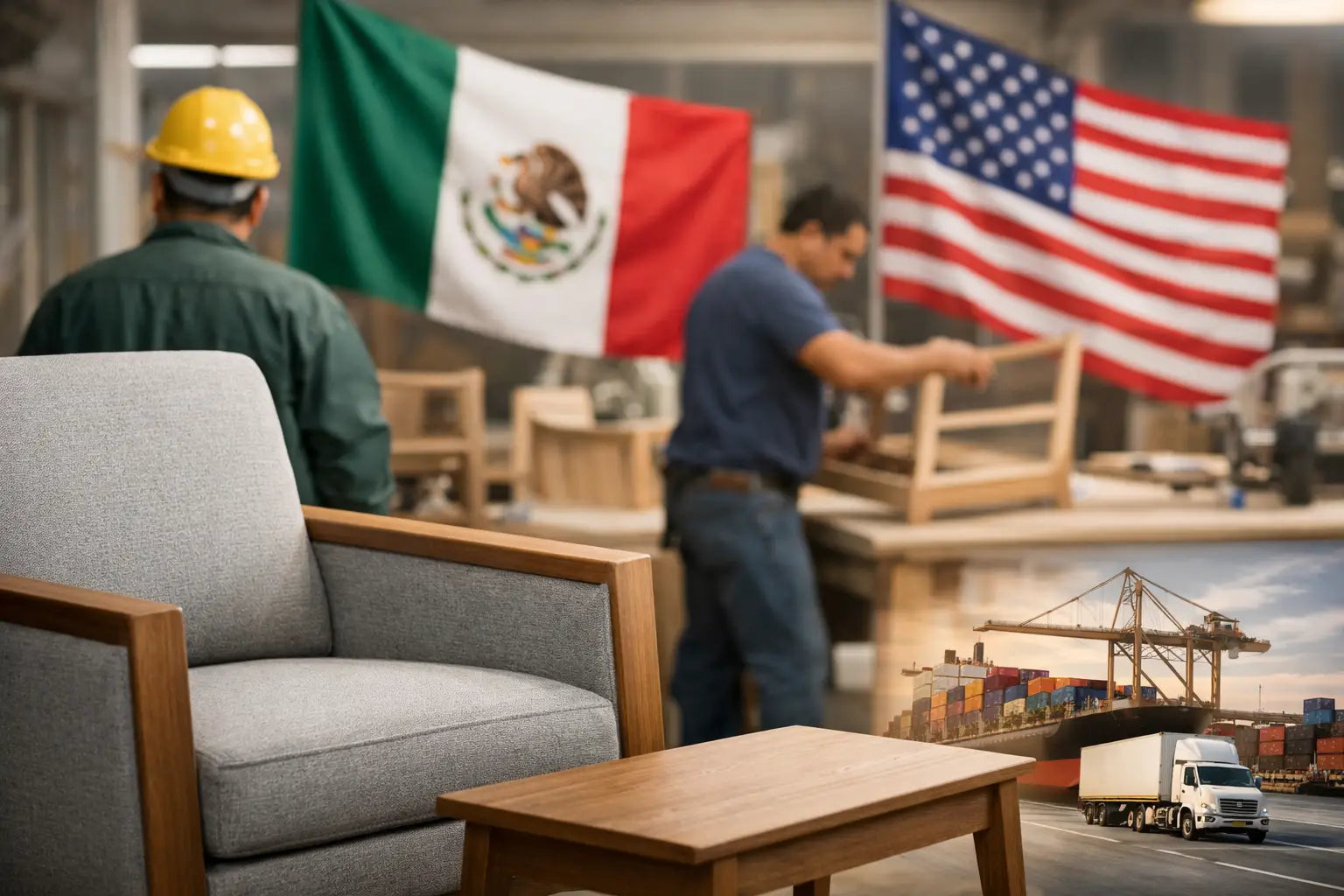
A delayed container of case goods can tie up capital for months. A missed upholstery delivery can leave a hospitality opening short on inventory. For U.S. buyers, furniture manufacturers in mexico offer a more controlled way to build, replenish, and customize furniture programs without accepting the long planning cycles common in offshore sourcing.
Mexico is not a one-size-fits-all furniture source. Factory capabilities vary widely by region, material, production method, and order volume. The opportunity is strongest when buyers match the right manufacturer to a clear product specification, a realistic cost target, and a replenishment plan that values speed as much as unit price.
Why Mexico works for furniture sourcing
Furniture is expensive to move, vulnerable to freight damage, and often difficult to reorder quickly. Those realities make proximity more valuable in this category than it may be for smaller consumer goods. A shorter transit route can reduce the time between a purchase order and a sellable product, while making it easier to respond when a colorway, finish, or SKU starts moving faster than forecast.
For many U.S. brands and retailers, Mexico also changes the working relationship. Similar business hours support faster approvals on stain samples, packaging artwork, construction changes, and production questions. Bilingual communication and more practical factory access can reduce the gap between what a buyer specifies and what reaches the warehouse.
Nearshore production can also support lower minimum order quantities than a large offshore program. That does not mean every Mexican factory is built for small orders. High-volume producers still need production efficiency, particularly for custom upholstery, molded components, and specialized finishes. But buyers can often test an assortment or launch a private-label collection with less inventory exposure than a container-driven sourcing model requires.
The trade-off is that Mexico is not always the lowest quoted ex-factory price. Labor-intensive, highly commoditized furniture may be cheaper elsewhere on a narrow unit-cost comparison. The more useful comparison includes freight, duty exposure, carrying cost, damage risk, cash tied up in inventory, and the cost of being unable to replenish a winner before the season ends.
What furniture manufacturers in Mexico can produce
Mexico's furniture sector covers far more than rustic wood furniture, though that remains an important strength. Buyers can source residential, commercial, hospitality, and outdoor products across a broad range of construction methods.
Wood furniture is a major category, including dining tables, bedroom collections, storage, consoles, shelving, and accent pieces. Manufacturers may work with solid hardwoods, engineered wood, veneer, MDF, plywood, or mixed-material construction. The material choice matters because it affects price, lead time, durability, carton weight, and how consistently a factory can reproduce a finish across production runs.
Upholstered furniture is another strong fit, especially sofas, occasional chairs, benches, headboards, dining seating, and commercial seating. Here, buyers should evaluate more than the appearance of a sample. Foam density, frame joinery, webbing or spring systems, fabric performance, seam consistency, and cushion recovery will determine whether the product holds up in customers' homes or high-use commercial spaces.
Metal, rattan, woven, and outdoor furniture are also available through specialized suppliers. Some factories focus on powder-coated steel frames and commercial-grade finishes. Others combine wood, metal, cane, or upholstery in contemporary collections. The right supplier is usually a specialist with proven experience in your product type, not simply a general factory willing to quote it.
Start with the product brief, not the price request
A vague request for "a modern dining chair" produces vague quotes. It also makes it difficult to compare suppliers fairly. Before approaching factories, create a brief that defines the commercial and technical requirements of the product.
At minimum, clarify dimensions, target materials, finish or fabric standards, expected annual volume, packaging requirements, target landed cost, and intended market. If the item will be sold online, include carton-size expectations, assembly requirements, drop-test needs, and photography-ready finish standards. If it is for hospitality, include performance requirements, fire standards where applicable, and the expected use environment.
For a private-label program, the brief should also state what can be customized. A factory may be able to change fabric, stain, hardware, label, carton artwork, or leg style without reengineering the entire product. Structural redesigns, custom tooling, and new molds require a different timeline and investment. Asking for customization without separating minor modifications from engineering work leads to inaccurate expectations on both sides.
A strong quote request gives buyers better leverage because it shows the manufacturer that the opportunity is organized. It also reveals whether a supplier can ask the right questions before committing to a number.
How to qualify a factory before placing an order
The best sample is not enough. Furniture manufacturing depends on repeatability, material control, packaging discipline, and production planning. Qualification should focus on whether the factory can consistently produce your item at scale.
Review the factory's actual product experience. Ask what similar pieces it currently produces, what materials it handles in-house, and which processes it outsources. Outsourcing is not automatically a problem. Many excellent furniture suppliers rely on specialist partners for metalwork, stone tops, foam, or upholstery. What matters is whether they control quality, scheduling, and accountability across those partners.
Evaluate capacity in practical terms. A factory may have open capacity today but lack the machinery, skilled labor, or finishing line capacity needed for your peak season. Ask about standard lead times, monthly output for comparable products, and how it handles rush replenishment. If your business depends on recurring purchase orders, assess the supplier's ability to reserve material and production space rather than treating every order as a new project.
Quality control should be specific to the category. For wood furniture, inspect moisture control, sanding, finish consistency, joint strength, and warping risk. For upholstery, confirm fabric inspection, foam specifications, stitch quality, frame construction, and final appearance checks. For all furniture, packaging deserves serious attention. Corner protection, carton strength, internal blocking, assembly hardware, and clear instructions can determine whether a product arrives saleable.
Finally, verify commercial discipline. Clear payment terms, documented specifications, approved samples, production milestones, and a process for handling defects are not administrative details. They are the operating system behind a reliable supplier relationship.
Build cost around the landed unit, not the factory quote
A lower factory quote can become a more expensive program once freight, packaging, duty, warehousing, damage, and inventory holding costs are included. Furniture buyers should model the landed unit cost and the cash cycle together.
Mexico can be especially compelling for bulky, slower-moving, or seasonally sensitive items because smaller and more frequent deliveries may improve working capital. Instead of purchasing inventory far ahead of demand, a buyer may be able to place a tighter initial order and use sales data to trigger replenishment. That flexibility can protect margin even when the ex-factory cost is slightly higher.
Still, nearshore sourcing requires disciplined logistics planning. Freight rates, border crossing processes, final-mile requirements, and warehouse receiving standards all affect the outcome. Flat-pack products may lower freight costs but increase assembly complexity and customer-service risk. Fully assembled items may improve the customer experience but consume more cubic volume. There is no universal answer. The best choice depends on your channel, product complexity, return rate, and delivery promise.
Use samples to validate the full production process
A development sample confirms design direction. It does not prove production readiness. Before approving a first purchase order, buyers should test the product as it will actually be sold and shipped.
That means reviewing the final material, color, finish, packaging, labels, assembly instructions, and carton markings. Measure the product and carton. Assemble it using only the included hardware and instructions. Test the stability, drawers, doors, cushions, or moving parts. If the product will be shipped through parcel networks, assess whether the packaging is designed for that reality rather than merely for a factory-to-warehouse transfer.
Pre-production samples are particularly valuable when a factory is introducing a new finish, new fabric, or custom packaging. They create a signed-off reference point for production inspection and reduce the risk of subjective disputes later.
FastLane helps buyers move this work out of fragmented email threads by giving them access to verified regional suppliers, direct quote conversations, and a more accountable sourcing process. The goal is not simply to find a factory. It is to create a supplier relationship that can support the next order as reliably as the first.
Choose the supplier that supports your replenishment model
The right Mexican manufacturer is the one that fits your commercial model, not necessarily the one with the lowest first quote. A DTC brand launching a limited collection may prioritize lower MOQs and quick sampling. A retailer may need consistent carton specifications and dependable replenishment. A hospitality buyer may value project management, compliance documentation, and finish consistency across hundreds of rooms.
Start with a tightly defined product brief, validate the sample and packaging under real conditions, and model the total cost of keeping inventory available. When those pieces are in place, Mexico becomes more than a convenient manufacturing location. It becomes a practical way to regain control over furniture sourcing and turn faster replenishment into a real competitive advantage.


